
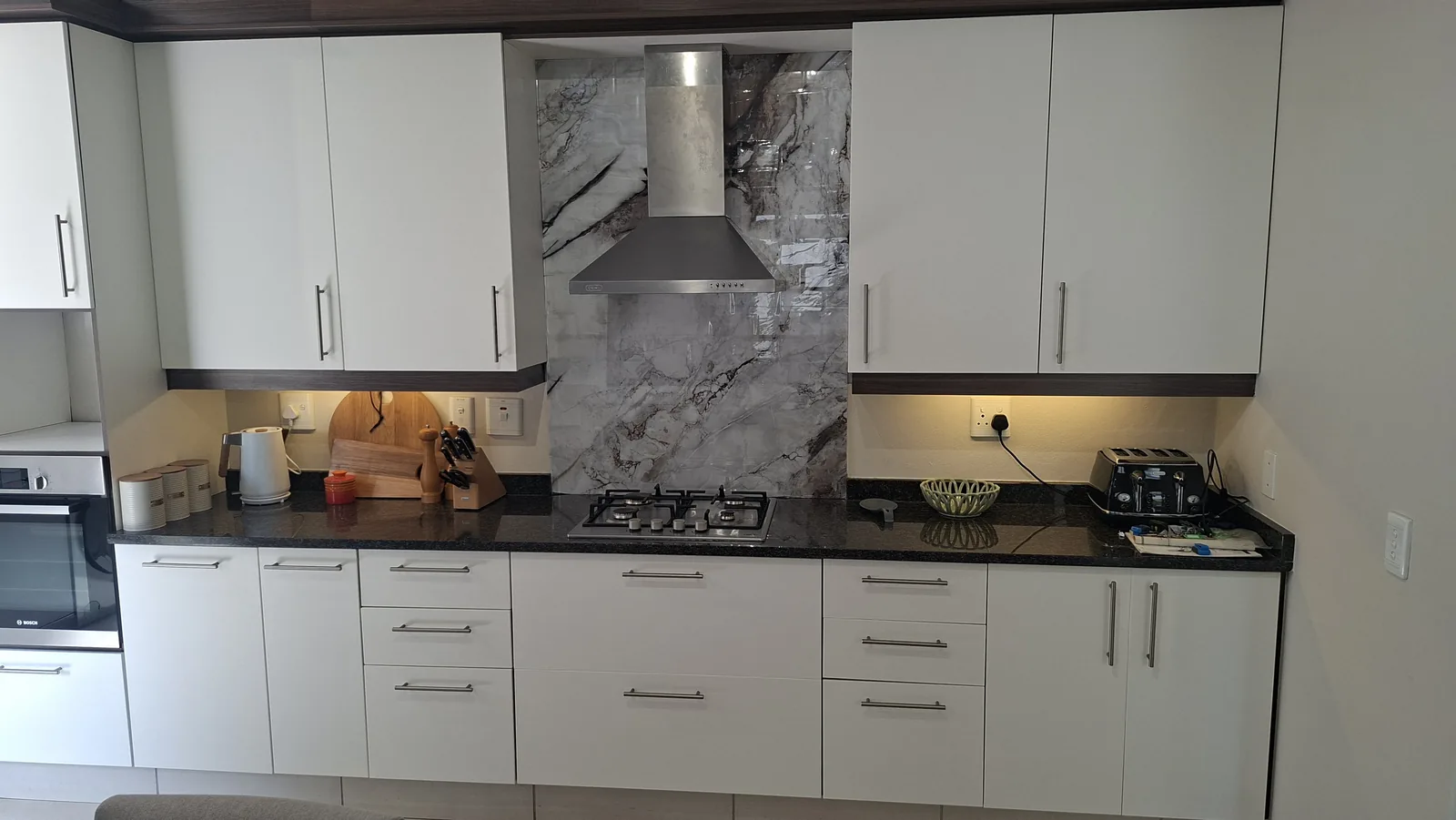
If your cupboard doors are structurally sound but the finish is dated, you have two realistic options that do not involve ripping the kitchen out. You can have them sprayed, or you can have them wrapped in architectural film.
Both work, and in this market they cost about the same. What separates them is what your doors are made of, the finish you are after, and how long you can live without a kitchen.
We wrap kitchens in Durban and KZN, so we have an interest here. We have also turned down jobs that were better off sprayed, and we say plainly below where that applies.
What is spray painting kitchen cupboards?
Spray painting is the application of a liquid coating to your existing doors and frames, usually with a spray gun rather than a brush or roller.
Doors are typically removed, cleaned, sanded or keyed, primed, sprayed in several coats, cured, and refitted. The better operators spray off site in a controlled booth. The finish is a paint film bonded to whatever is underneath it.
What is kitchen wrapping?
Kitchen wrapping is the application of a self-adhesive architectural film over the existing door, drawer front or panel.
The surface is cleaned and prepared, the film is cut and applied, and edges are wrapped around the back of the door so no join is visible from the front. Nothing is sprayed and nothing is replaced. The result is a factory-style finish with a consistent colour and texture.
Which lasts longer on the KZN coast?
Architectural film generally holds up better in coastal conditions, but installation quality matters more than the material on both sides.
Three things drive failure in Durban kitchens specifically:
- Humidity attacks adhesion on any finish applied to a surface that was not fully dry or fully clean.
- Salt air near the coast is harder on coatings than inland air.
- Steam and heat around hobs, kettles and dishwashers stress the finish at edges and joins first.
Quality architectural film is rated for 10 to 15 years indoors when correctly installed. A well-executed respray by a competent operator will also last years. A badly prepared job in either method will start lifting or chipping inside eighteen months, usually at a door edge near the kettle.
Ask both suppliers the same question: what is the warranty, and what specifically voids it?
What does each cost?
Both routes land in a similar band. Neither is the budget option and neither is the premium one, so price is rarely what decides it.
Kitchen wrapping starts from R400 per door, supplied and installed. A complete kitchen typically lands between R20,000 and R40,000, because a full wrap covers far more than the doors alone. A full kitchen replacement in this market runs R180,000 to R330,000, so either refinishing route saves you the great majority of that. Current pricing and the finishes available are on our kitchen cupboard wrapping service page.
What actually varies between quotes is scope, not rate. Two quotes that look far apart are usually covering different amounts of kitchen. Check both against the same list:
| Item | What to confirm |
|---|---|
| Cupboard doors | How many, and whether both faces are finished |
| Drawer fronts | Counted separately from doors, and often are |
| Side and end panels | Frequently excluded |
| Plinths and kickboards | Frequently excluded |
| Splashback | Film can cover this. Spraying generally cannot |
| Counters | Film can cover this. Spraying generally cannot |
| Handles | Refitted, or replaced at extra cost |
| Warranty | The term, and specifically what voids it |
That last pair matters more than most people expect. A kitchen where the doors change but the splashback and counters stay dated reads as new doors on an old kitchen, not as a new kitchen.
How long are you without a kitchen?
This is the practical difference between the two, and for most people it is what decides the job.
Wrapping is done in place. Most kitchens take one to two days on site. There is no spray booth, no solvent smell and no doors away at a workshop, so you can generally use the kitchen in the evenings while the work is underway.
Spraying usually means the doors leave. They are removed, taken off site, prepared, sprayed and then left to cure properly before they come back and are refitted. Depending on the operator and their queue, that commonly means several days to a week or more living with open cupboards.
For a family kitchen that is an inconvenience you can plan around. For a rental between tenants, or a house going on show, it is lost days you are paying for either way.
If a sprayer offers to work in place instead, ask what gets masked, how overspray is controlled and how long the house will smell of solvent afterwards.
What finishes can you get?
Spray painting gives you effectively unlimited colour, in a matt, satin or gloss sheen.
Architectural film gives you colour plus materials you cannot spray: woodgrains, stone and marble effects, brushed metals, concrete looks and textured finishes. If you want your cupboards to read as oak or your splashback to read as marble, film does that and paint does not.
If your heart is set on one exact colour and nothing else, spraying has the edge. If you want a material look, film wins outright.
When spray painting is the better choice
There are kitchens we will tell you to have sprayed.
- Heavily moulded or ornate doors. Deep profiles, routed detail and raised panels are difficult to wrap cleanly. Film needs to lie down into detail without bridging or lifting at the corners.
- You want a specific colour match to existing joinery or a paint code, and no film in the range is close enough.
- The doors are solid timber with an open grain you want to keep visible under colour.
In those cases a good sprayer will give you a better result than we will, and we would rather say so than take the job.
When wrapping is the better choice
- Flat or lightly profiled doors, which covers most kitchens built in the last twenty years.
- Melamine, veneer and board doors, where film bonds predictably to a stable surface.
- You want a woodgrain, stone or metallic look rather than a flat colour.
- You need the kitchen back quickly and cannot lose the doors for a week.
- The splashback and counters need to change too. Film handles those surfaces in the same visit and the same finish family.
What about cupboards that are damaged?
Neither method fixes a damaged substrate, and any supplier who tells you otherwise is selling you a callback.
If doors are swollen at the bottom edge from water, delaminating, or have blown at the corners, the damage needs to be dealt with before any finish goes on. Swelling in particular will telegraph through film and will show through paint.
Send photographs of the worst door before you get quotes. It changes the answer.
Is this worth doing on a rental property?
This is where refinishing makes the most obvious financial sense.
A tenant-ready kitchen refresh between leases at R20,000 to R40,000, completed in a day or two, is a very different proposition from a R180,000 renovation and weeks of lost rental income. Landlords in Durban North, Umhlanga, Ballito and the Midlands increasingly refinish rather than replace for exactly this reason.
It is also where turnaround stops being a convenience question and becomes a cost. A vacant unit earns nothing, so the difference between two days on site and a week waiting for doors to come back from a booth is real money, not just inconvenience. If the property is between tenants with a date to hit, that alone usually settles which method to use.
The same logic applies to a property being prepared for sale, where the kitchen is the room that decides how the rest of the house is read.
How to decide
Work through these in order:
- How long can you be without a working kitchen? If the answer is days rather than a week, that points to film.
- What are your doors made of? Melamine, veneer and board suit film. Heavily moulded or open-grain timber may suit spraying.
- How detailed are the door profiles? Flat and lightly profiled favours film.
- Do you want a colour or a material? Woodgrain, stone and metallic effects mean film.
- Does the splashback or counter need to change too? Film covers those. Spraying generally does not.
- Is anything damaged? Sort the substrate first, whichever route you take.
- Get both quotes on identical scope, and ask both for the warranty in writing. Price will likely be close. Scope and turnaround will not.
If the honest answer points to spraying, have it sprayed. If it points to film, we would like to quote it.
Frequently asked questions
Can you wrap over a kitchen that has already been painted?
Sometimes, and it depends entirely on how well the paint is bonded. If the existing coating is lifting or chalky, film applied over it will fail with it. We check this on site before quoting.
Can you paint over a wrapped kitchen later?
Not directly. The film would be removed first, and the surface underneath assessed.
Does wrapping smell or leave fumes?
No. There are no solvents involved in application.
How long does a full kitchen take?
Typically one to two days on site, depending on the number of doors and surfaces.
Do you do splashbacks and counters as well?
Yes. Film is applied to splashbacks, counters, side panels and plinths as well as doors, which is what makes the finished result look like a new kitchen rather than new doors on an old one.
Full pricing, finishes and the install process are on our kitchen cupboard wrapping service page. Send us a few photos of your kitchen on WhatsApp and we will tell you what is possible, what to watch out for, and whether wrapping or spraying is the better fit for your doors. If it is spraying, we will say so.